Skip to content

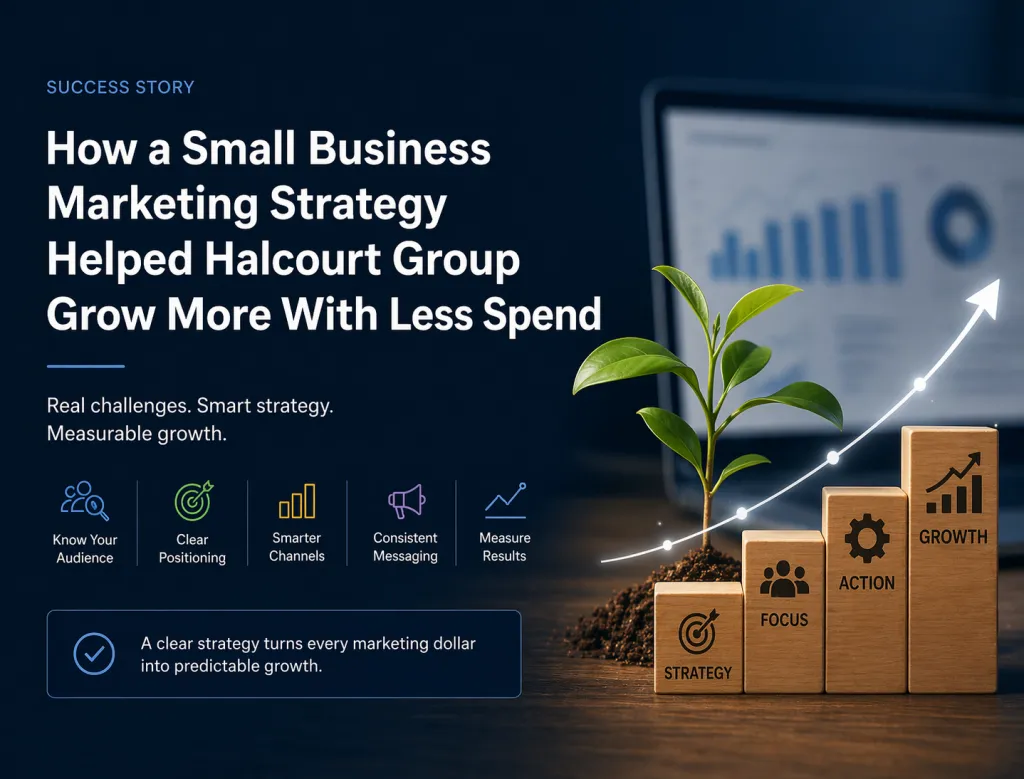
Most small business owners don’t have a marketing problem. They have a strategy problem – they just don’t know it yet.
They’re spending on ads that don’t convert. Running campaigns that feel disconnected. Chasing every new platform or tactic that someone tells them they should be on. And somewhere in the middle of all that activity, they lose track of what the marketing is actually supposed to do.
That’s exactly where Halcourt Group found themselves last year: busy, active, and investing in marketing without a clear small business marketing strategy to guide it.
A small business marketing strategy is the plan that defines who you want to reach, how you position your business, which channels you focus on, and how you measure results. Without it, marketing turns into disconnected activity instead of predictable growth.
This is the story of what changed, what they did differently, and what every SMB owner can learn from it.
| CHAPTER 1 The Marketing That Never Had a Strategy |
A Business That Looked Fine on the Surface
Halcourt Group is a 22-person professional services firm with a strong reputation, long-standing clients, and a founder who built the business over more than a decade.
But for the past two years, revenue had been flat. Not declining – just stuck. The business had grown for years on reputation, referrals, and the occasional trade event, but that was never the same thing as having a real marketing strategy. When growth slowed, there was no strategic foundation to build from.
So they did what most SMBs do. They started trying things.
The Pattern of Scattered Tactics
A round of Facebook ads that didn’t quite work. An email campaign that produced a few opens but no replies. A LinkedIn push that lasted about six weeks before quietly fading out. A website refresh that looked better but didn’t change the results. A podcast idea that never got past episode two.
Every new thing started with hope and ended with a shrug. No one could say what was working and what wasn’t. The marketing spend kept growing, the calendar kept filling up, and somehow the pipeline kept shrinking.
None of these tactics was inherently wrong. The problem was that none of them were connected to a clear audience, message, or measurable goal.
“They weren’t lacking effort. They were lacking direction.”
The Symptoms Nobody Could Quite Name
The founder started noticing things that, on their own, seemed small. The brand voice felt different depending on the platform. The sales team kept complaining about lead quality. Some prospects came in asking about services the company didn’t even offer anymore. The website, the social content, and the sales pitch all described the business differently.
Looking back, the issue was clear: their positioning, messaging, channels, and goals were out of sync. What looked like a marketing performance problem was really a strategy problem.
| CHAPTER 2 Why Small Business Marketing Tactics Fail Without Strategy |
Halcourt Group’s situation is common because many small businesses mistake activity for strategy.
Tactics Answer “How.” Strategy Answers “Who,” “Why,” and “What.”
Running a Facebook ad is a tactic. Sending an email is a tactic. Posting on LinkedIn is a tactic. These are all “how” decisions – they describe the method, not the purpose.
Strategy is different. Strategy answers the bigger questions: Who exactly are we trying to reach? Why should they care about us specifically? What do we want them to do, and what will move them to do it?
Without those answers, every tactic is a guess. Some of them land. Most of them don’t.
The Hidden Cost of Marketing Without a Plan
Most SMBs vastly underestimate what scattered marketing actually costs them. It’s not just the wasted ad spend or the abandoned campaigns. The real cost is the loss of momentum – the slow erosion of team energy, confidence, and time that comes from working hard on things that don’t add up.
SMBs also tend to copy tactics from larger brands without the audience research, brand recognition, budget, or channel infrastructure that make those tactics work. What looks like a great approach for a national company can be completely wrong for a 22-person business serving a specific market.
| → Key Takeaway: Strategy isn’t a luxury for large brands. It’s the filter that makes every tactic smarter – and the foundation that makes every marketing dollar work harder. |
| CHAPTER 3 What a Small Business Marketing Strategy Should Include |
For many SMBs, strategy feels abstract, which is exactly why it gets skipped. So let’s make it practical.
What became clear at Halcourt Group was that a real small business marketing strategy depends on five things. Once those were clear, every tactical decision got easier. If any of them are missing, the whole structure becomes unstable. If all five are in place, everything else – the tools, the tactics, the campaigns – becomes dramatically more effective.
| 01 | Clarity on the ideal customer | Define who you serve by industry, company size, buyer role, pain points, and buying triggers. The more specific, the more useful. |
| 02 | Clear positioning and message | Articulate your value proposition, your key differentiator, your promise, and the proof that backs it up. Say it the same way across every channel. |
| 03 | Defined goals and KPIs | Set targets that connect to business outcomes: qualified leads, consultation bookings, close rate, customer acquisition cost, and conversion rate. |
| 04 | A focused channel strategy | Choose channels based on where your buyers actually look for answers, how long their sales cycle is, and what content format fits them best. |
| 05 | Measurement and optimization | Assign ownership of a monthly performance review. Run a quarterly strategy check. Build a simple dashboard and hold the team accountable to it. |
Notice what’s not on this list: specific tactics. No mention of which ad platform to use or which email tool to buy. Those decisions come later, and they come more easily once the strategy is clear.
Without these foundations, every tactical decision is made in isolation. With them, every decision becomes a simple test: does this serve the strategy, or doesn’t it?

| CHAPTER 4 The Turning Point: Strategy Before Spend |
Back to Halcourt Group. The turning point wasn’t dramatic. It didn’t involve a new tool, a new hire, or a bigger budget. It started with the founder asking a different kind of question.
Instead of asking, “What should we try next?” they started asking, “What are we actually trying to do?”
Stopping Before Starting
The first decision was counterintuitive: stop. They paused low-performing campaigns, stopped adding new channels, and reviewed performance against business goals instead of activity metrics.
For a business that had spent two years adding more, pulling back felt uncomfortable. But it was necessary. You can’t build a foundation while you’re still running.
Talking to the People Who Actually Mattered
Next, they did something most SMBs skip: they talked to their customers. Real conversations with real buyers. What made them choose Halcourt Group in the first place? What almost made them choose someone else? What did they wish the company offered or communicated better?
The answers surprised everyone. Among the things they learned:
- Buyers cared more about responsiveness and clarity than breadth of services.
- Prospects were confused by inconsistent positioning across channels.
- The strongest buying trigger was trust, not feature depth.
The value customers actually cared about was different from the value the marketing had been selling.
Making Deliberate Choices
With real customer insight in hand, the team made three deliberate choices:
- Clarified positioning: stopped trying to be everything to everyone and committed to a focused message built around what real buyers actually responded to.
- Set three specific, measurable goals for the next 12 months: tied to real business outcomes like qualified leads generated, conversion rate, and revenue growth.
- Chose SEO/content and LinkedIn as primary channels, because they aligned best with the firm’s consultative buying journey and target audience. Everything else was paused, not permanently, but until the core was working.
“The shift wasn’t about doing more. It was about doing less – with more clarity, intention, and confidence.”
| CHAPTER 5 What Happened Next: 12 Months of Focused Growth |
The results didn’t come overnight. The first 60 days felt slower, not faster – which is always the hardest part of a strategy shift. When you’re used to constant activity, a deliberate pace can feel like inaction.
But by the end of the first quarter, the signals started showing up. And by the end of 12 months, the numbers told a clear story.
Note: Illustrative composite outcomes below are based on common SMB patterns.
| 40% Drop in cost per qualified lead | 2X Website conversion rate | 30% Revenue growth in 12 months | Lower Total marketing spend, improved lead quality |
What Changed Behind the Numbers
Cost per qualified lead dropped meaningfully because the new messaging spoke directly to the right audience, so fewer wrong-fit prospects filled the pipeline, and the right-fit ones engaged faster.
Website conversion rate nearly doubled after the homepage and services pages were rewritten around what real buyers actually wanted to know.
The sales team reported fewer poor-fit inquiries and more prospects who already understood the company’s offer, differentiation, and value.
Revenue grew in the range of 30% year over year. Not because the business was doing more marketing, but because it was doing the right marketing.
The Unexpected Benefit
Some of the biggest changes didn’t show up in a dashboard. They showed up in how the team worked. For the first time in years, everyone knew what they were working toward. The marketing conversations stopped being about tactics and started being about outcomes. The sales team and the marketing team started collaborating instead of blaming each other for pipeline gaps.
Halcourt Group didn’t become a different business. They just became a clearer, more focused version of the business they already were.
| CHAPTER 6 What Your SMB Can Learn From Halcourt Group |
The Halcourt Group story isn’t unique. It’s a pattern we see repeatedly: SMBs that feel stuck in their marketing are rarely stuck on tactics. They’re stuck on strategy.
Here’s what a small business marketing strategy can look like in your own business.
| 01 | Pause the tactics | Audit current spend, leads, conversions, CAC, and channel contribution. Be honest about what’s working and what isn’t. |
| 02 | Get clear on your ideal customer | Talk to real buyers. Identify your best-fit customers by industry, size, pain point, and sales cycle length. |
| 03 | Define your message and positioning | Write a one-sentence positioning statement. Build a 3-5 point messaging hierarchy and test it against what your best customers actually say. |
| 04 | Choose 2–3 focused channels | Use SEO and content when buyers search for answers. Use LinkedIn or email when your audience is relationship-driven. Use paid search when intent is high and the sales cycle is short. Say no to the rest for now. |
| 05 | Set goals and measure quarterly | Define targets like “30 qualified leads per month” or “a 20% improvement in conversion rate.” Review them every 90 days. Adjust based on what the data tells you. |

Red Flags That You’re Operating Without a Real Strategy
If you’re not sure whether your current marketing is truly strategic, these are the warning signs we see most often:
- You can’t clearly describe your ideal customer in one or two sentences.
- Your team gives different answers when asked what your business does or who it’s for.
- Your website, sales conversations, and marketing content all describe the business differently.
- You add new marketing activities more often than you evaluate old ones.
- You don’t have specific, measurable goals tied to business outcomes.
- You don’t know which channels are actually producing results and which are draining time.
If two or more of these feel familiar, the issue isn’t your tactics. It’s your strategy, and the good news is that it’s fixable.
The Multiplier That Makes Everything Work
Halcourt Group’s turnaround didn’t require more money. It required more clarity. That’s the part of the story that matters most, and it’s the part that’s available to every small business that’s willing to pause, think, and rebuild their small business marketing strategy from the ground up.
Strategy is a multiplier that gives the rest of the marketing direction. It helps you choose the right channels, sharpen the message, and spend with more confidence. Without it, marketing stays reactive. With it, the work starts to compound.
Most small businesses do not need more activity. They need a strategy they can actually follow.
| Does your marketing feel busy but not productive? The fix usually isn’t another tool. It’s a real strategy. WSI Digital Path helps SMBs build one – grounded in your business, your buyers, and your goals. |

Tali is a results-driven digital marketer with a track record of growing her clients’ businesses and driving revenue.
As the business owner at WSI Digital Path, Vaughan, she takes great pride in delivering powerful but cost-effective solutions for her clients.
Innovative and revolutionary digital marketing trends set the pace for the digital marketing industry. Don’t make the mistake of falling behind! Contact WSI Digital Path today and trust your digital marketing to the industry’s leading professionals.