Skip to content

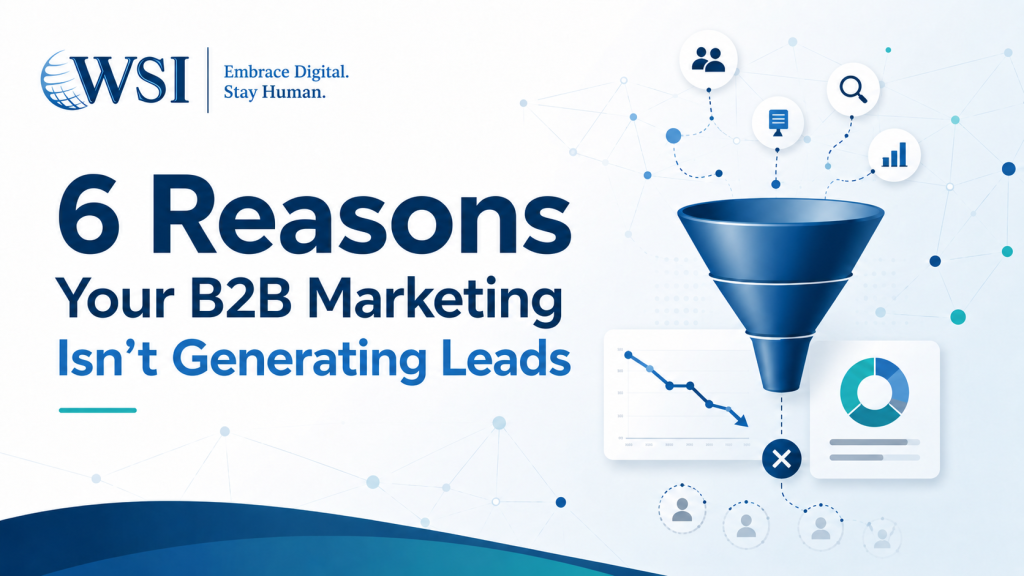
If your B2B company is doing all the right things: posting on LinkedIn, running Google Ads, updating your website, sending email campaigns, and leads are still inconsistent, you’re not alone.
A lot of B2B small and mid-sized businesses are experiencing the same thing right now. Fewer form submissions. Higher cost per lead. More unqualified inquiries that waste your sales team’s time. And a growing frustration that marketing spend isn’t translating into real pipeline.
Here’s the thing: the problem usually isn’t that your marketing isn’t working. The problem is that the way B2B buyers make decisions has fundamentally changed, and most SMBs are still using playbooks that were built for a different era.
This post breaks down why B2B lead generation has gotten harder, where most companies are losing potential buyers, and what to fix first before spending more money on ads or content.
B2B Lead Generation Has Changed, But Many SMBs Haven’t
Ten years ago, a B2B company could run a Google Ads campaign, drive traffic to a basic service page, and expect a reasonable number of leads. Today, that rarely works without a much stronger supporting foundation.
Here’s what’s different:
- B2B buyers do significantly more independent research before speaking with anyone in sales
- Buying decisions at most companies involve multiple people, not just one decision-maker
- Buyers are comparing vendors quietly, often through AI search tools, Google, review platforms, LinkedIn, and industry-specific communities
- They expect genuinely useful information before they ever fill out a form
- A generic website with thin service pages no longer creates enough trust to move someone to action
This doesn’t mean lead generation is broken. It means the bar is higher. And companies that understand that are pulling ahead.
| Lead Generation Barrier | Problem | Common Symptoms | Actionable Fix | Strategy | Expected Outcome |
| Uninformed or generic website content | Credibility | Research-heavy buyers drop off; site focuses on company features rather than solutions; thin service pages. | Create content that answers pre-contact questions: comparison pages, FAQs, and problem-solution blog posts. | Attract/Convert | Establishment of trust before the first conversation and improved engagement with informed buyers. |
| Website traffic is not converting to leads | Website | High rankings and traffic (vanity metrics) but minimal lead form submissions or pipeline growth. | Audit website for conversion: clarify target audience, use plain language, and add visible CTAs on every page. | Convert | Transformation of existing traffic into inquiries by simplifying the next step for the user. |
| Poorly structured Google Ads (PPC) | Visibility/Process | High cost-per-click; leads appear valid but are poor-quality or the “wrong fit” for sales. | Tighten campaign structure, use dedicated landing pages, and implement strict negative keyword controls. | Measure/Improve | Reduced wasted spend and higher-quality inquiries that align with sales team requirements. |
| Keyword-focused SEO rather than intent-focused | Visibility | High SEO rankings that fail to translate into inquiries; thin content that does not build authority. | Develop content based on buying intent and prospect questions (e.g., “how to choose”) rather than just search volume. | Attract | Long-term visibility and trust-building that captures buyers actively researching specific solutions. |
| Slow or generic lead follow-up | Process | Qualified leads go quiet or disappear; response times exceed 2-3 days; no immediate lead confirmation. | Implement a follow-up system: send immediate email confirmations and perform personal outreach within one business day. | Nurture | Improved recovery of leads and higher conversion rates from initial inquiries into real opportunities. |
| Random marketing tactics without a strategy | Relationship | Inconsistent lead flow; scattered efforts across LinkedIn, Ads, and Email without a cohesive message. | Build a B2B roadmap defining the ideal customer profile (ICP), problems solved, and channel integration. | Improve | A unified marketing system where results compound over time and connect directly to revenue. |
Reason #1: Your Buyers Are More Informed Before They Contact You
By the time a B2B prospect reaches out, they’ve often already done a significant amount of research. They may have read competitor websites, watched YouTube videos, scanned LinkedIn posts from industry experts, and even asked an AI tool to summarize their options.
When they land on your website, they’re not starting from zero. They’re evaluating you.
A manufacturer looking for a new industrial supplier might already know the certifications they need, the lead times they require, and the red flags to watch for before they ever contact you. A professional services buyer might have read two or three competitors’ case studies before they reach your homepage.
If your website or content doesn’t meet that standard, if it’s still largely about who you are rather than what problems you solve and how, you’ll lose that buyer before the conversation even starts.
What to fix:
Create content that answers the questions your buyers are already asking before they contact you. Think: comparison pages, FAQ pages, industry-specific service pages, problem-solution blog posts, case studies with real outcomes, and service pages that are specific enough to be credible.
Reason #2: Website Traffic Is Not the Same as Leads
A lot of B2B SMBs focus their energy on getting more traffic through SEO, paid ads, or social media. Traffic matters, but traffic alone doesn’t pay the bills.
A website can rank on page one of Google, get consistent clicks, and still generate almost no leads. If the website doesn’t do its job: building trust, explaining services clearly, and making it easy to take the next step, traffic is just a vanity metric.
Some of the most common reasons B2B websites fail to convert traffic into leads:
- The homepage talks about the company, not the buyer’s problem
- Service pages are too thin to be convincing
- There’s no clear next step or call-to-action visible on key pages
- There’s no proof: no case studies, no client results, no testimonials
- The mobile experience is slow or difficult to navigate
- Paid campaigns send traffic to the homepage instead of a dedicated landing page
What to fix:
Before increasing ad spend, audit your website for conversion. Can a visitor understand exactly what you do within five seconds? Is your target audience clear? Do you explain your services in plain language? Do you have proof that you’ve solved this problem before? Is there a visible, compelling call-to-action on every key page?
Reason #3: Google Ads Are More Competitive and Less Forgiving
B2B keywords can be expensive. Depending on your industry, cost-per-click can range from $10 to $60 or more. That means a poorly structured campaign doesn’t just underperform; it burns through budget quickly.
Many B2B SMBs run Google Ads campaigns that generate leads on paper but deliver poor-quality inquiries in practice. The sales team gets leads that aren’t the right fit, and marketing gets blamed for wasted spend. Neither side is actually wrong: the problem is usually in the campaign structure, the landing page, or the feedback loop between marketing and sales.
Common B2B PPC issues that erode lead quality:
- Sending all ad traffic to the homepage instead of a purpose-built landing page
- Using broad match keywords without enough negative keyword control
- Not separating campaigns by service line or target industry
- No call tracking or form tracking, so you can’t tell which campaigns are generating real opportunities
- No connection between form submissions and CRM data
- Optimizing for volume of leads rather than quality of leads
- No remarketing strategy to re-engage visitors who didn’t convert on the first visit
What to fix:
Before increasing your ad budget, tighten your campaign structure, fix your landing pages, and set up proper conversion tracking.
Then build a feedback loop:
Campaign → Landing Page → Conversion Tracking → CRM → Sales Feedback → Optimization
Reason #4: SEO Is No Longer Just About Ranking for the Right Keywords
Keyword rankings still matter, but they’re no longer the whole story. B2B buyers use AI-powered search tools, Google’s own AI-generated results, LinkedIn, YouTube, and industry-specific platforms, often before they ever click on a traditional search result.
What this means for your SEO strategy: thin blog posts optimized for keyword volume are far less effective than they used to be. Search engines and buyers are rewarding content that demonstrates real expertise, answers specific questions, and builds genuine trust over time.
What effective B2B SEO looks like today:
- Strong, specific service pages that explain outcomes, not just services
- Industry-specific landing pages when you serve distinct verticals
- Educational blog content built around actual buyer questions
- FAQ content that addresses objections and comparisons
- Case studies with real, measurable results
- Internal linking that connects related content into a clear topic cluster
- Schema markup and technical SEO fundamentals
- Content that’s updated regularly, not published once and forgotten
What to fix:
Stop creating content based on keyword volume alone. Start creating content based on buying intent. Ask your sales team: what questions do prospects ask most before they become clients? What objections do you hear most often? What comparisons are buyers making? That’s your content roadmap.
Good examples of intent-driven B2B content topics:
- “How to Choose a Commercial HVAC Filter Supplier”
- “Questions to Ask Before Hiring a Construction Marketing Agency”
- “Custom Manufacturing vs. Off-the-Shelf: What B2B Buyers Need to Know”
- “How Much Should Google Ads Cost for a Small B2B Business?”
Reason #5: Lead Follow-Up Is Often Too Slow or Too Generic
Lead generation doesn’t end when someone submits a form. In fact, what happens in the 24 hours after a form submission is often the biggest factor determining whether that lead becomes an opportunity or disappears.
Many B2B SMBs lose qualified leads not because of bad marketing, but because of a slow, impersonal, or nonexistent follow-up process. A buyer who contacts three companies and hears back from one of them within the hour is likely to have a conversation with that company, regardless of which vendor’s website was best.
Common follow-up gaps that cost B2B companies real revenue:
- No immediate confirmation email when a form is submitted
- No CRM system to track where the lead came from or what they were looking for
- Personal follow-up takes two or three business days instead of one
- Follow-up emails are generic rather than relevant to the specific inquiry
- No process for leads that aren’t ready to buy yet
- Marketing has no visibility into which campaigns generate leads that actually close
What to fix:
Build a simple lead follow-up system. Immediate confirmation email. Personal outreach within one business day. A relevant resource based on what they were asking about. A second touch-point with a question. A third with a relevant case study. And a monthly nurture email for leads that aren’t ready yet. That system alone can recover a significant portion of leads that are currently going quiet.
Reason #6: Random Tactics Without a Strategy Don’t Add Up
LinkedIn posts. Google Ads. Email newsletters. Blog content. These are all legitimate marketing activities. But they only generate consistent leads when they’re connected to a clear, unified strategy.
The distinction matters: tactics are activities. Strategy decides which activities matter, how they connect, and how they move a buyer from awareness to inquiry to sale.
Many B2B SMBs invest in individual marketing activities without a clear thread connecting them. The result is scattered effort, inconsistent lead flow, and a lot of money spent without a clear understanding of what’s actually working.
What to fix:
Build a simple B2B lead generation roadmap. It doesn’t need to be complex but it should answer these questions: Who is your best-fit customer? What problems are they trying to solve? What makes you different from your competitors? Which channels will you use, and how do they work together? What does your website need to do? How will you track results? How does marketing connect to sales?
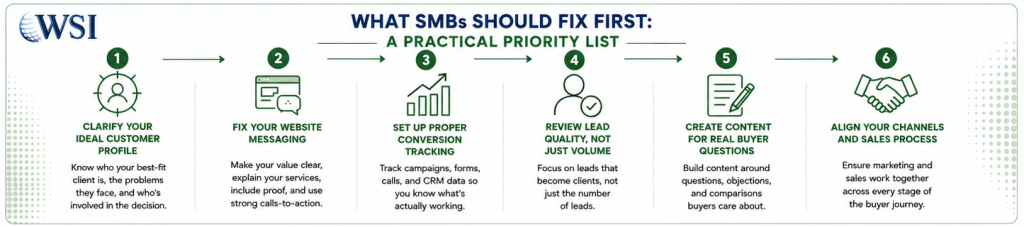
What SMBs Should Fix First: A Practical Priority List
If you’re seeing inconsistent lead flow, higher cost per lead, or lower-quality inquiries, here’s where to start in priority order.
1. Clarify Your Ideal Customer Profile
Who is your best-fit client? Which industries do you serve most effectively? What size company? What problems trigger the search for a company like yours? Who’s involved in the decision? The clearer your answer, the sharper every other part of your marketing becomes.
2. Fix Your Website Messaging
Your homepage should make it immediately clear what you do, who you serve, and what makes you the right choice. Service pages should be specific enough to be convincing. Every key page should have a clear, relevant call-to-action. And there should be enough proof, client results, case studies, specific outcomes, to build real credibility.
3. Set Up Proper Conversion Tracking
If you can’t track which campaigns, keywords, and landing pages are generating qualified leads, you’re optimizing blind. Set up Google Analytics 4, call tracking, form tracking, and CRM source attribution before spending more on paid media.
4. Review Lead Quality, Not Just Volume
Which leads actually became clients? What campaigns generated poor-fit inquiries? Which keywords attracted buyers who were never going to convert? That analysis will tell you more about what to fix than any dashboard metric.
5. Create Content for Real Buyer Questions
Talk to your sales team. What questions do prospects ask most? What objections do they raise? Which comparisons are they making? Build content around those conversations: blog posts, FAQ pages, comparison pages, case studies, and connect them to your service pages through internal linking.
6. Align Your Channels and Your Sales Process
Paid search captures active demand. SEO builds long-term visibility and trust. Email nurtures buyers who aren’t ready yet. Sales convert real interest into revenue. Your website connects everything. When these work together, the results compound over time.
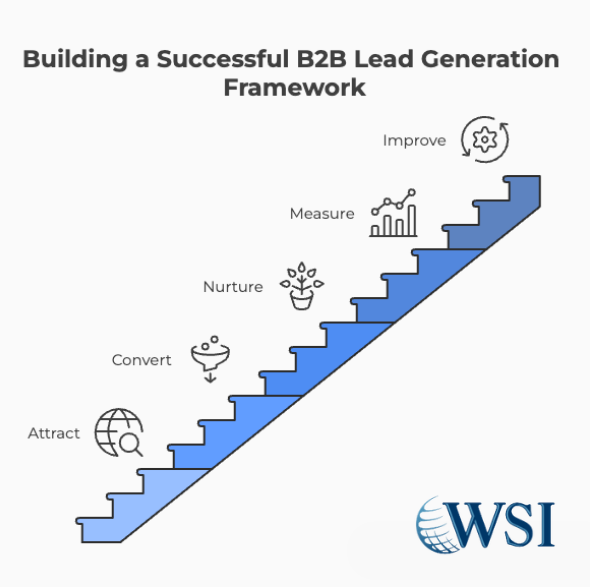
A Simple B2B Lead Generation Framework for SMBs
If you’re rebuilding your lead generation approach, here’s a simple framework to work from:
- Attract
SEO, Google Ads, LinkedIn, referrals, industry content, and local search: the goal is to be visible when the right buyer is actively looking.
- Convert
Landing pages, clear calls-to-action, trust signals, case studies, and lead magnets: the goal is to turn visitors into inquiries.
- Nurture
Email sequences, retargeting, educational content, and a consistent follow-up process: the goal is to stay in front of buyers who aren’t ready yet.
- Measure
Lead source, cost per lead, lead quality, conversion rate, sales-qualified leads, and revenue impact: the goal is to know what’s working and what isn’t.
- Improve
Monthly reviews, A/B testing, keyword refinement, content updates, and regular sales-to-marketing feedback: the goal is to get better every cycle.
When Should a B2B SMB Reconsider Its Lead Generation Approach?
If you’re seeing more than one or two of the following, it’s worth taking a step back and assessing the full picture:
- Leads have slowed down noticeably over the past six to twelve months
- Cost per lead has increased without a corresponding increase in lead quality
- Your sales team consistently says the leads coming in aren’t the right fit
- Website traffic is flat or declining
- Google Ads are spending budget but not converting into real opportunities
- SEO rankings aren’t translating into meaningful inquiries
- Competitors seem more visible online than they used to
- You rely heavily on referrals and don’t have a reliable way to generate new business outside of them
- Marketing reports don’t connect clearly to revenue outcomes
Any one of these is worth investigating. Several of them together usually point to a strategy problem, not just a tactics problem.
The Biggest Mistake: Spending More Before Fixing the Funnel
The most common mistake B2B SMBs make when leads slow down is spending more on ads, or producing more content, or trying a new channel, without first understanding where potential buyers are being lost.
More ad spend won’t fix unclear messaging. High traffic won’t fix a website that doesn’t convert. Many blog posts won’t fix a weak content strategy. More leads won’t help if the follow-up process is broken.
Before asking “How do we get more leads?”, the better question is: “Where are we losing potential buyers right now?”
The answer usually falls into one of five categories:
- They’re not finding you: a visibility problem
- They’re finding you but not trusting you: a credibility problem
- They’re clicking but not converting: a website problem
- They’re submitting forms but not being followed up with: a process problem
- They’re not ready yet, and not being nurtured: a relationship problem
Finding your specific answer and fixing it will generate better results than any additional spend.
Frequently Asked Questions
| Q: Why is B2B lead generation getting harder? |
Buyers are researching more independently, comparing more vendors, using AI tools and search engines to evaluate options, and taking longer to make decisions. The bar for what counts as a credible, trustworthy vendor has risen significantly in the past few years.
| Q: What is the biggest mistake small businesses make with lead generation? |
Spending more on ads or creating more content before fixing the website, tracking, messaging, and follow-up process. Investment in traffic only pays off when the foundation is strong enough to convert that traffic into real opportunities.
| Q: Are Google Ads still effective for B2B lead generation? |
Yes, but they work best when campaigns are tightly structured, landing pages are purpose-built, tracking is accurate, and there’s a clear feedback loop between lead quality and campaign optimization. Without those elements, Google Ads can generate leads that look good in a report but never become real business.
| Q: How does SEO help B2B lead generation? |
SEO helps your company be visible when buyers are actively researching their problem, comparing options, and looking for a credible provider. Done well, it builds sustained inbound lead flow that doesn’t disappear when you pause your ad spend.
| Q: What should a B2B SMB fix first to get better leads? |
Start with your ideal customer profile, your website messaging, your conversion tracking, your lead quality data, and your sales follow-up process. Those five things will tell you more about what’s going wrong and what to do next than almost anything else.
Is Your B2B Lead Generation Working the Way It Should?
If your company is generating fewer leads, dealing with lower-quality inquiries, or getting inconsistent results from SEO, Google Ads, or your website, the issue is usually something specific and fixable. It just takes the right diagnosis before adding more spend.
WSI Digital Path helps B2B small and mid-sized businesses identify exactly where their lead generation is breaking down, and build a practical, integrated strategy to fix it. Whether the problem is your website, your ad campaigns, your content, or your follow-up process, we’ll help you find it and build a clear path forward.
Ready to find out where your leads are going? Let’s talk.

Tali is a results-driven digital marketer with a track record of growing her clients’ businesses and driving revenue.
As the business owner at WSI Digital Path, Vaughan, she takes great pride in delivering powerful but cost-effective solutions for her clients.
Innovative and revolutionary digital marketing trends set the pace for the digital marketing industry. Don’t make the mistake of falling behind! Contact WSI Digital Path today and trust your digital marketing to the industry’s leading professionals.