Skip to content

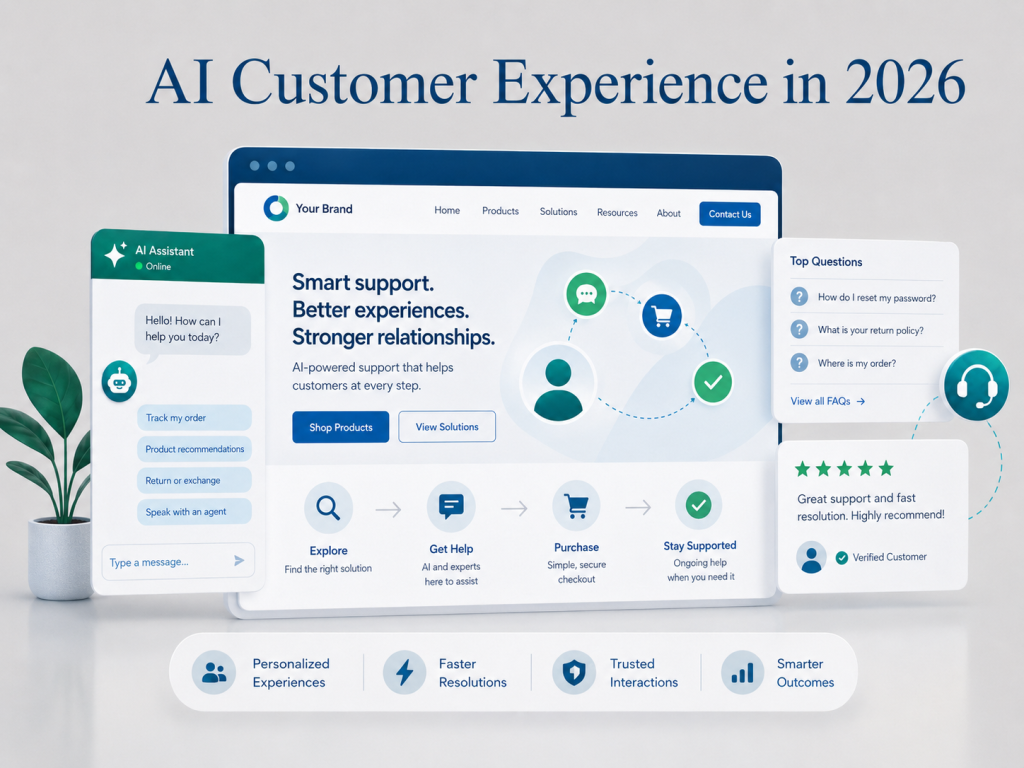
AI customer experience is no longer just about chatbots or automation. In 2026, AI is changing how people search for businesses, compare options, ask questions, and decide who to contact. Customers are used to faster answers, more relevant recommendations, and fewer unnecessary steps. When a website, sales process, or support experience feels slow, vague, or difficult to use, people notice quickly.
For small and mid-sized businesses, this does not mean replacing every human interaction with automation. It means building a digital experience that answers common questions, helps visitors compare options, builds trust early, and makes it easy to reach a real person when the decision becomes more complex.
This article explains what customers expect from digital experiences in 2026 and what businesses should improve across their websites, support channels, and customer journeys.
| Customer Expectation | What Businesses Should Improve |
| Fast answers, clear information, helpful support, and fewer unnecessary steps. | Improve website content, FAQs, chat support, trust signals, page speed, and conversion paths before adding more tools. |
Why AI Has Changed Customer Experience
Customers now compare your business with the best digital experiences they use every day. They may discover you through Google Search, AI Overviews, ChatGPT-style tools, social media, referrals, or direct search. By the time they reach your website, they usually want specific answers, proof that you are credible, and a clear next step.
That makes customer experience a marketing issue, a sales issue, and an SEO issue at the same time. If your website does not clearly explain what you do, who you help, where you work, why you are credible, and what someone should do next, both AI tools and human visitors have less to work with.
| Previous Expectation | 2026 Expectation | What This Means for Your Website |
| “I can wait for a reply tomorrow.” | “I expect an answer now, or I will keep comparing.” | Add clear FAQs, service pages, quote forms, chat, and visible contact options. |
| “I will call to ask basic questions.” | “I want pricing context, process details, and proof before I call.” | Explain common questions before the sales call. |
| “A generic service page is enough.” | “I want to know if this business understands my exact situation.” | Use industry examples, case studies, testimonials, and practical scenarios. |
| “AI is separate from the website.” | “AI search and AI tools use website content to understand businesses.” | Make content clear, crawlable, specific, and easy to summarize. |
1. Customers Expect Answers Before They Contact You
One of the biggest changes in AI customer experience is the shift from “contact us for details” to “help me understand before I contact you.” Visitors want to know whether you solve their problem, whether you work with businesses like theirs, and what will happen after they submit a form.
This is especially important for B2B and service-based companies. Buyers may not be ready to speak with sales immediately, but they are still judging your business. A thin service page can make a strong company look less credible than a competitor with clearer, more helpful information.
What to Fix on Your Website
- Add short answer sections near the top of important service pages.
- Create FAQs that answer real buying questions, not generic keyword questions.
- Explain your process, timelines, deliverables, and what happens after someone contacts you.
- Show who your service is best suited for and who it is not suited for.
- Make contact options visible without forcing visitors to hunt through the site.
For example, a B2B service company should not rely on a short “contact us to learn more” page. A stronger page would explain who the service is for, what problems it solves, what the first conversation includes, what information the prospect should prepare, and what happens after the consultation request is submitted.
2. Customers Compare Businesses Faster Than Before
AI search and comparison-driven browsing make it easier for customers to evaluate several businesses quickly. This does not mean every visitor is looking for the cheapest option. Many are looking for the clearest, safest, and most credible option.
If your content sounds like every other company in your market, customers have less reason to choose you. Strong AI customer experience content should help people compare, not just persuade them with broad claims.
| Generic Wording | Better 2026 Content |
| “We provide high-quality digital marketing services.” | “We help B2B service companies improve lead quality through SEO, paid search, conversion tracking, and website optimization.” |
| “Our team is experienced.” | “Our team has experience helping local and B2B companies improve visibility, reduce wasted spend, and turn website traffic into qualified leads.” |
| “Contact us to learn more.” | “Book a consultation if you want to understand which channels are producing leads, which pages are losing visitors, and which fixes should come first.” |
For example, a local service business can build trust by showing service areas, reviews, response times, team information, photos, FAQs, and a clear booking process. A B2B company may need different proof, such as case studies, client industries served, process details, reporting examples, and clear consultation steps.
3. Personalization Has to Be Useful, Not Creepy
Personalization is still important, but customers are more sensitive to how businesses use their data. The goal is not to make people feel watched or tracked. The goal is to make the experience feel relevant, timely, and helpful.
For many SMBs, useful personalization can be simple. A returning visitor might see industry-specific resources. A lead who downloaded a guide might receive a follow-up email that matches the topic they viewed. A customer who asked about one service should not receive a generic promotion for an unrelated offer.
| Personalization Opportunity | Useful Approach | Avoid |
| Email follow-up | Send a resource related to the page or form topic. | Sending the same generic newsletter to every contact. |
| Website content | Show relevant case studies by industry or service need. | Using vague “recommended for you” blocks with no clear logic. |
| Sales handoff | Give the sales team context about the pages viewed or questions asked. | Making the prospect repeat everything they already submitted. |
| Chat support | Use chat history to continue the conversation smoothly. | Pretending the chatbot knows more than the customer shared. |
4. AI Chat Must Solve Real Problems
An AI chatbot can improve customer experience, but only when it is designed around real customer needs. A chatbot that blocks people from reaching a human, gives vague answers, or cannot handle common questions can quickly erode trust.
The best AI chat experiences are focused, practical, and well-managed. They answer common questions, qualify leads, route inquiries, collect useful context, and hand off to a person when needed.
Good vs. Weak AI Chatbot Use
| Use Case | Good Chatbot Experience | Weak Chatbot Experience |
| Lead qualification | Asks industry, location, budget range, timeline, and service need before sending the lead to the right team member. | Only asks for a name and email, then says someone will reply. |
| Customer support | Answers common questions and provides links to relevant resources. | Gives generic answers that do not match the customer’s situation. |
| Booking | Shows available appointment types and explains what happens next. | Forces the customer to fill out a long form with no context. |
| Escalation | Clearly offers a human handoff for complex or urgent questions. | Traps the visitor in a loop with no way to reach a person. |
5. Trust Signals Are Now Part of the Customer Experience
Trust is no longer something customers evaluate only at the end of the journey. In 2026, trust is part of every digital interaction. AI tools can summarize your website, but they cannot invent credibility that is missing from the page.
This is why strong customer experience pages include proof: case studies, reviews, expert insights, clear service descriptions, real team information, transparent policies, and helpful answers. These elements support both human readers and search visibility because they make the content more specific and useful.
| Trust Signal | Why It Matters | Example |
| Case studies | Shows real outcomes and context. | A short case study explaining the client’s problem, the solution provided, and the measurable result. |
| Reviews/testimonials | Reduces perceived risk. | A testimonial from a business owner explaining the problem, solution, and result. |
| Author or team expertise | Shows there are real experts behind the advice. | A short author bio with relevant marketing, strategy, or technical experience. |
| Clear process | Helps prospects understand what happens next. | A 3-step process: discovery call, audit, implementation plan. |
| Pricing context | Prevents poor-fit inquiries and reduces uncertainty. | “Most projects start with an audit before a monthly plan is recommended.” |
6. Human Support Still Matters for Complex Decisions
AI can speed up simple tasks, but many customer decisions still require human judgment. This is especially true for B2B services, technical purchases, healthcare-related services, financial decisions, legally sensitive topics, and high-value projects.
The best customer experience does not hide the team behind automation. It uses AI to reduce repetitive work so people can spend more time on strategy, problem-solving, and relationship-building.
- Use AI for first responses, FAQs, routing, summaries, and basic qualification.
- Use people for strategy, negotiation, emotional situations, custom recommendations, and high-value decisions.
- Make the handoff clear: customers should know when they are speaking with AI and how to reach a person.
- Review AI outputs regularly so inaccurate or outdated answers do not become part of the customer experience.
Customer Experience Checklist for 2026
Use this checklist to identify where your digital experience may be falling behind customer expectations.
| Area | Question to Ask | Priority |
| Website clarity | Can a visitor understand what you do, who you help, and why you are credible within 10 seconds? | High |
| Service pages | Do your pages answer real buying questions before asking for a form submission? | High |
| AI/chat | Does chat solve common problems or only collect contact details? | Medium/High |
| Trust signals | Do you show proof through case studies, reviews, process details, and team expertise? | High |
| Speed/mobile | Is the experience fast and usable on mobile devices? | High |
| Personalization | Are follow-ups and recommendations based on real customer behavior? | Medium |
| Human handoff | Can customers reach a person easily when the situation is complex? | High |
| Measurement | Are you tracking qualified leads, conversion paths, engagement, and customer questions? | High |
How to Start Improving Your AI Customer Experience
You do not need to rebuild your entire website, tech stack, or customer journey at once. Start with the places where customer confusion, slow responses, or weak trust signals are most likely costing you leads.
A Practical 30-day Plan
| Week | Focus | Actions |
| Week 1 | Find friction | Review top landing pages, GA4 engagement, form drop-offs, chat logs, and common sales questions. |
| Week 2 | Improve clarity | Rewrite key service pages, add FAQs, simplify CTAs, and make next steps more visible. |
| Week 3 | Add proof | Add case studies, reviews, process details, examples, and industry-specific content. |
| Week 4 | Test AI support | Improve chat prompts, lead routing, automated follow-ups, and human handoff rules. |
The strongest approach is to improve the customer journey first, then add AI where it removes friction. AI should support the experience, not cover up a weak one.
Customer Expectations Have Already Changed
AI customer experience in 2026 is about more than automation. It is about clarity, speed, relevance, trust, and better decision-making. Customers want fast answers, but they also want confidence that they are choosing the right business.
For SMBs, the opportunity is practical. Make your website easier to understand, your service pages more useful, and your next steps easier to follow. Use AI to answer common questions and route leads. Show real proof. Bring in human expertise when the decision matters.
Businesses that do this well will not just “use AI.” They will create a better customer experience, one that helps people move from search to trust to action with fewer barriers.
Ready to Improve Your Customer Experience?
WSI Digital Path helps small and mid-sized businesses improve digital strategy, website performance, SEO, automation, and customer experience. If your website is getting traffic but not enough qualified leads, we can help you identify which pages, forms, messages, and follow-up steps need attention first.
Contact WSI Digital Path to discuss how your business can improve its AI customer experience and digital strategy for 2026.
Frequently Asked Questions
| Q: What is AI customer experience? |
AI customer experience is the use of artificial intelligence to improve how customers search, compare, contact, buy from, and receive support from a business. It can include AI chat, smarter content, personalization, automated follow-ups, and better routing to human support.
| Q: How is AI changing customer expectations in 2026? |
AI is making customers expect faster answers, more relevant content, clearer comparisons, and fewer unnecessary steps. Customers are less willing to wait for basic information that should be easy to find online.
| Q: Do small businesses need AI chatbots? |
Not every small business needs a complex chatbot, but many can benefit from AI-assisted chat when it answers common questions, qualifies leads, routes inquiries, and offers a clear human handoff.
| Q: What should businesses fix before adding AI tools? |
Businesses should first fix website clarity, service page content, FAQs, page speed, trust signals, contact options, conversion paths, and lead tracking. AI works better when the digital foundation is strong.

Tali is a results-driven digital marketer with a track record of growing her clients’ businesses and driving revenue.
As the business owner at WSI Digital Path, Vaughan, she takes great pride in delivering powerful but cost-effective solutions for her clients.
Innovative and revolutionary digital marketing trends set the pace for the digital marketing industry. Don’t make the mistake of falling behind! Contact WSI Digital Path today and trust your digital marketing to the industry’s leading professionals.