Skip to content

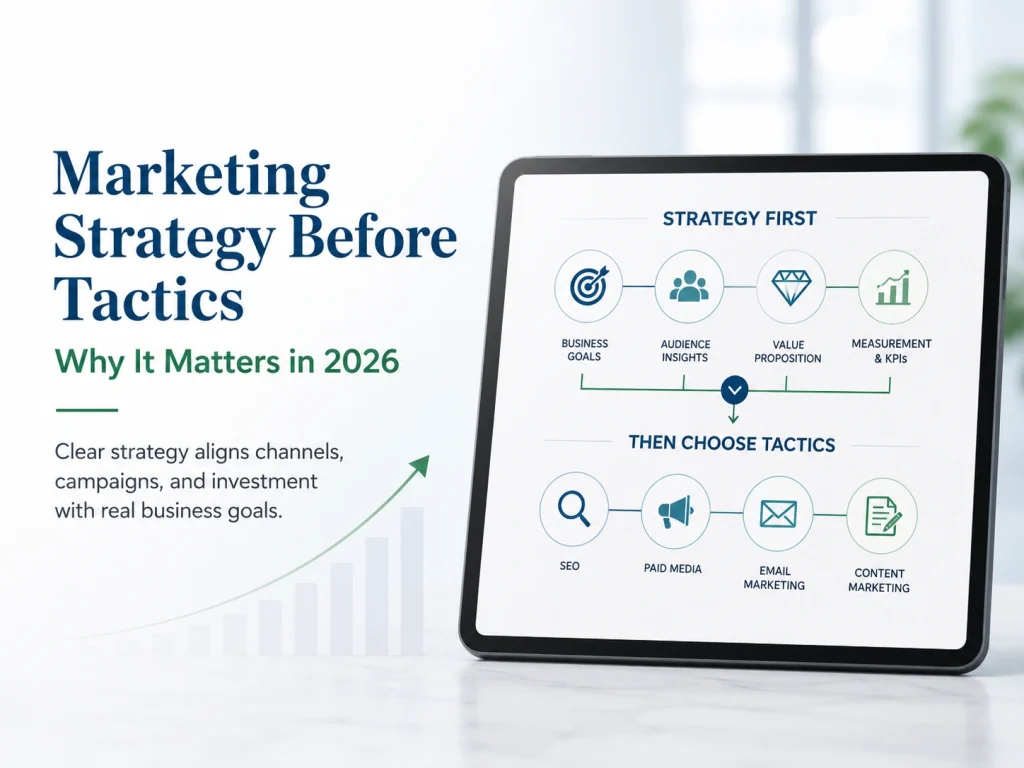
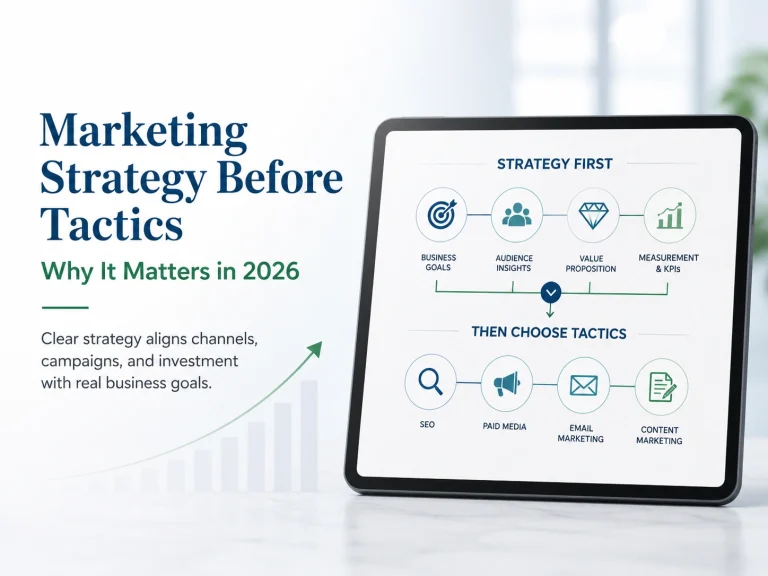
Putting marketing strategy before tactics ensures that every campaign, channel, and investment supports a defined business objective. Strategy determines where the business will compete, whom it needs to influence, what value it will communicate, and how success will be measured. SEO, paid media, email, social content, video, and AI tools can then be chosen because they serve that direction, not because they are fashionable or easy to launch.
In 2026, the cost of getting this sequence wrong is growing. Marketing teams can produce campaigns, pages, reports, and creative assets faster than ever, while customers discover information through traditional search results, AI-generated answers, social platforms, industry forums, and professional communities. Speed is useful, but it can also scale the wrong message, target the wrong audience, or optimize a metric that has little connection to revenue.
Strategy establishes the direction and the criteria for making decisions. Tactics put those decisions into practice.
|
The clearest way to see the difference between strategy and disconnected tactics is through a practical example. The manufacturing SEO case study shows how defined priorities influenced the work, the measurement process, and the decisions that followed.
Manufacturing Case Study: Strategy-First SEO in Practice
| The following case study is based on seven monthly SEO reports covering December 2025 through June 2026. The company name, product names, and identifying details have been removed. The figures have been presented conservatively, and the case study does not make revenue or ROI claims that the source data cannot support. |

The Challenge
A North American manufacturer of specialized industrial components had an established website, an extensive technical product range, and customers in Canada and the United States. The company had many possible pages, products, and search topics to promote. That breadth created a strategic risk: SEO activity could easily become a sequence of unrelated monthly tasks.
The initial question was therefore not, “Which page should we optimize this week?” It was, “Which parts of the website and search market matter most to the business over the next quarter?”
The Strategic Decisions
The program selected a small number of priority commercial pages, including the homepage and a key product category, and organized work around 90-day focus periods. The stated goals included improving relevant search visibility, increasing first-page rankings, strengthening organic conversions, and growing clicks and impressions. A set of 173 cornerstone keywords was tracked across the Canadian and US markets.
This limited focus created continuity. Instead of changing direction whenever an individual metric moved, the team could evaluate the same priority pages, keyword groups, and conversion actions over several months. That made it possible to distinguish short-term volatility from a meaningful trend.
The plan connected several disciplines rather than treating them as separate deliverables:
- On-page optimization for selected commercial pages.
- Off-page work to support authority around those priorities.
- Technical SEO, site-health improvements, and indexing management.
- Local citations and Google Business Profile activity as supporting visibility work.
- Monthly measurement against the same focus pages, keyword groups, and conversion actions.
The order of work changed as the program matured. After the priority pages had been optimized, the next phase emphasized internal links from existing educational content to relevant product and category pages. The objective was to use the website’s existing content more effectively, improve navigation from technical research to commercial information, and support conversions without repeatedly editing recently optimized pages. A later phase introduced structured data on selected categories while continuing technical and authority-building work.
The Results
The reports tracked movement across several important indicators:
Metric | Starting Point | Later Result |
| Organic sessions | 1,978 in December | 2,698 in June, approximately 36% growth |
| First-page keywords | 90 in December | Peak of 98 in April; 79 in June |
| Website conversion actions | 24 in December | Peak of 39 in May; 29 in June |
| Contact thank-you page events | 12 in December | Peak of 22 in May; 18 in June |
| Technical site-health score | 81 | 93 by June |
| AI referral sessions | 25 in February | 48 in June |
| Priority category impressions | 298 in December | More than 4,000 at the Q2 peak |
Performance improved overall, but rankings, conversions, and page-level clicks continued to fluctuate. That variation is important because it shows how the strategy helped the team interpret mixed signals rather than report only the metrics that increased.
What the Data Does Not Prove
Credible case studies need boundaries. These reports demonstrate improvements in organic sessions, search visibility, tracked website conversions, and technical health. They do not include sales-qualified lead data, pipeline value, closed revenue, or customer acquisition cost. It would therefore be inaccurate to claim a specific revenue increase or return on investment.
The absence of revenue data identifies the next measurement priority. Website inquiries should be connected with CRM outcomes so the business can distinguish a tracked conversion from a qualified opportunity and, ultimately, closed revenue.
This example shows the outcome of a strategy-first approach, but the reasoning behind it applies beyond SEO. To understand why the sequence worked, it is useful to separate marketing strategy from the tactics used to execute it.
What Is a Marketing Strategy?
A marketing strategy is the set of choices that connects a company’s business objectives with a defined market, customer, position, and route to growth. It explains who the business is trying to influence, why those people should choose it, which barriers must be removed, which channels have a role, and which outcomes will indicate progress. A practical marketing strategy framework turns these choices into a sequence that the team can use to evaluate opportunities, assign resources, and guide execution.
A strategy is not a list of deliverables. Instructions such as “post three times a week,” “run Google Ads,” “publish four articles,” or “improve SEO” describe activity, but they do not explain the business problem being solved. A useful strategy makes trade-offs. It identifies which audiences, offers, markets, and opportunities deserve attention and which initiatives should not be prioritized yet.
Marketing Strategy vs Tactics: What Is the Difference?
Marketing Strategy Decides | Marketing Tactics Determine |
| The business objective | Which campaigns will be launched |
| The priority audience | Which channels will reach them |
| The position and value proposition | Which messages and formats will be used |
| The customer journey | Where and when content will appear |
| The measures of success | Which platform metrics will be monitored |
| What will not be prioritized | How the selected work will be executed |
Strategy answers questions such as:
- Which business objective should marketing support over the next 6 to 12 months?
- Which customer segments and buying situations offer the strongest opportunity?
- What position, promise, and proof will make the company meaningfully different?
- How does the buyer move from awareness to evaluation, inquiry, and purchase?
- What should be measured at each stage of that journey?
Tactics answer a different question: what will the team do to execute those choices? SEO may capture existing demand. Paid media may accelerate reach. Technical content may build trust during a long evaluation. Email may nurture known prospects. A case study may reduce perceived risk. The correct mix depends on the strategy; there is no universally correct channel checklist.
In the manufacturing case study, the strategy determined which commercial pages, markets, keywords, and outcomes deserved attention. On-page SEO, technical improvements, internal linking, citations, and structured data were the tactics chosen to support those priorities.
Why a Strategy-First Approach Matters More in 2026
AI Has Increased Output Faster Than Strategic Clarity
AI can accelerate research, personalization, production, and analysis, but it cannot determine what a business should stand for without reliable inputs and clear priorities. Gartner’s 2026 CMO Spend Survey found that marketing leaders were allocating an average of 15.3% of their budgets to AI initiatives, while only 30% described their AI readiness as mature or fully developed. Average marketing budgets remained nearly flat at 7.8% of company revenue.
The survey included 401 marketing leaders and primarily represented organizations with more than $1 billion in annual revenue. It is therefore not a direct benchmark for every small or mid-sized company, but it illustrates a broader risk: organizations can invest in tools faster than they build the data, governance, processes, and strategic clarity required to use them effectively.
A weak strategy plus AI does not become a strong strategy. It becomes a weak strategy executed at greater speed. The team may create more content, launch more variations, and automate more workflows while still lacking a clear ideal customer, differentiated message, or measurement model.
AI Search Rewards Useful, Original and Expert-Led Content
Google’s current guidance states that the same foundational SEO practices continue to support visibility in generative AI search features. Pages still need to be accessible, technically sound, clearly structured, and useful. Labels such as AEO and GEO matter less than content built around real customer questions, firsthand knowledge, and original insight.
For B2B and manufacturing companies, this means the most valuable content will rarely be a generic summary assembled from other websites. It is more likely to be a technical explanation, product-selection guide, comparison, application insight, engineer-led answer, original data set, or customer example grounded in real operating experience.
Budgets Require Sharper Choices
When budgets are constrained, prioritization is not optional. A business that treats every channel as essential will spread time and money too thinly. A business with a clear strategy can fund the channels that match customer behaviour, pause low-value work, and set realistic time horizons for results.
Content Marketing Institute’s 2026 B2B research supports the same conclusion. Among marketers who reported improved content effectiveness, 74% credited strategy refinement, while 51% credited the implementation of new technology. The findings suggest that tools can amplify good decisions, but technology alone cannot compensate for weak customer understanding, unclear priorities, or disconnected marketing activity.
What a Practical Marketing Strategy Framework Should Include
A useful business marketing strategy does not need to become a 70-page presentation that nobody uses. For most small and mid-sized businesses, a concise working document is more valuable, provided it records the decisions needed to guide budgets, messaging, channels, content, and measurement.
1. A Specific Business Objective
Begin with the commercial outcome, not the channel. “Grow qualified inquiries from industrial buyers in the United States” is more useful than “increase website traffic.” The first objective shapes audience, geography, offer, content, channel, and measurement. The second can be achieved by attracting visitors who will never buy.
2. A Defined Market and Buying Group
Identify the companies, applications, roles, and buying situations that matter. In B2B markets, one sale may involve technical evaluators, operations, procurement, finance, and senior leadership. Each person may need different evidence, but the messages must still support one coherent position.
Reliable audience data is also essential for meaningful personalization. HubSpot’s 2026 research found that 93.2% of surveyed marketers said personalized or segmented experiences had generated more leads and purchases, while only 65% reported having high-quality audience data. Personalization works best when it is built on a clear understanding of the customer. Software can support that process, but it cannot supply the insight on its own.
3. Positioning, Value Proposition and Proof
Clarify why the right customer should choose the business instead of an alternative. Effective positioning is specific enough to influence decisions. It may be built around technical performance, reliability, application expertise, speed, service, risk reduction, total cost, or another advantage the company can prove. Claims need evidence: specifications, certifications, test data, expert insight, customer outcomes, or operational experience.
4. A Mapped Customer Journey
Customers do not experience marketing as separate departmental channels. They may discover a technical article, return through branded search, review a product category, download a resource, speak with sales, and revisit the website before acting. Mapping that journey reveals which questions and obstacles must be addressed, and where content, search, media, and sales enablement should connect.
5. Channel Roles and a Content System
Each channel should have a clear role in the wider strategy. SEO can help the business appear when potential customers are actively researching a problem, while LinkedIn may be more useful for sharing specialist knowledge with a defined professional audience. Paid search can support high-intent product categories, and email can keep the business visible to existing contacts over a longer buying cycle. The website then brings these activities together by building confidence and giving visitors a clear path to take the next step. Channels should reinforce one another rather than operate as disconnected publishing calendars.
6. A Measurement Hierarchy
Separate business outcomes from leading indicators. Revenue, sales-qualified pipeline, and new-customer acquisition may be the ultimate outcomes. Inquiries, sales-qualified leads, conversions, and product-page engagement may indicate progress. Rankings, impressions, clicks, and traffic are useful diagnostic measures, but they are not automatically proof of business impact.
7. A Sequenced Roadmap
Turn the strategy into focused 90-day priorities. A roadmap protects the team from switching direction whenever a single metric moves. It also creates review points where the business can assess what changed, what was learned, and which tactic should come next.
What Happens When Tactics Come First?
Tactics-first marketing often looks productive. There are campaigns in the market, social posts in the calendar, new blogs on the site, and dashboards full of data. The problem becomes visible when someone asks how those activities connect to the company’s most important growth objective.
You can often spot tactics-first marketing when:
- Traffic grows, but qualified inquiries and pipeline value do not.
- Content topics are chosen by search volume alone, with little relationship to priority products or customer questions.
- Paid campaigns send visitors to weak pages because the offer and conversion journey were never resolved.
- Every month introduces a new priority, so no initiative receives enough time to create or demonstrate an effect.
- Teams report channel metrics but cannot explain business contribution.
- AI is used to scale production before quality standards, expertise, and brand voice have been defined.
Poorly chosen tactics waste more than the marketing budget. They also tie up the team with work that does little to strengthen the company’s position or help potential customers move closer to a decision.
Why the Case Supports Strategy Before Tactics
Returning to the manufacturing case study, the results do not show that every SEO metric improved each month. Instead, the case shows why defined priorities and review periods matter when performance moves unevenly. Rankings shifted, conversions declined after their May peak, local visibility moved independently from organic search, and individual page results varied. The existing strategy allowed the team to evaluate those changes without abandoning the broader objective after every monthly fluctuation.
Because the program had defined priorities, KPIs, and review periods, the team could interpret performance in context. It identified the December traffic decline as seasonal rather than as evidence that the strategy needed to change immediately. It protected recently optimized pages from unnecessary repeated edits. It shifted toward internal linking when that was the more logical use of existing content, then added structured data and continued technical work as the program evolved.
That consistency helped the team decide what to do next. Monthly reports showed when to continue and when to adjust, without reopening recently optimized pages unnecessarily.
How to Put Marketing Strategy Before Tactics: A Seven-Step Framework
A business can continue marketing while its strategy is being developed, provided there is enough clarity to keep the next investments focused and measurable. The earlier framework describes what a marketing strategy should contain. The steps below show the order in which a business can develop and apply it.
- Define one primary business outcome for the planning period. Make it specific enough to influence choices about audience, market, offer, and timing.
- Identify the priority customer segments and buying situations. Include the roles involved, the problems they are trying to solve, and the evidence they require.
- Clarify the position and message. State why the company is relevant, different, and credible in language the customer can understand.
- Map the decision journey. Document the important questions, risks, objections, and information needs from discovery through purchase.
- Audit existing assets and channels. Determine what already supports the strategy, what needs improvement, and what should be stopped.
- Choose a limited set of tactics and assign each one a role. Avoid funding a channel simply because competitors use it or because a new tool makes it easy.
- Set a 90-day roadmap with leading and business indicators. Review results at agreed intervals, learn from the data, and update the plan without abandoning the objective after every fluctuation.
A useful plan does not need to be long, but it does need to follow a clear order. Start with the business goal and the audience, then define the positioning, message, channels, and measures of success. That sequence gives the team a practical basis for deciding what to do next.
Put Marketing Strategy Before Tactics
In 2026, effective marketing depends on making clear strategic choices while remaining flexible about execution. AI, SEO, paid media, content, and data can all support growth in different ways. Their value depends on how well they serve the company’s priorities and give customers a clear reason to choose the business. The manufacturing case study illustrates the practical value of that sequence: priorities remained stable, while the tactics evolved in response to evidence and changing needs.
Strategy provides the direction. When priorities are clear, tactics become easier to prioritize, teams can interpret performance more intelligently, and new tools can be adopted without allowing the tool to become the plan.
If you’re not sure whether your current marketing plan is genuinely strategic or simply busy, WSI Digital Path helps connect business objectives with SEO, content, and digital campaigns. Contact our team to develop a prioritized 90-day marketing roadmap before increasing your marketing spend.
Frequently Asked Questions
Why Should Marketing Strategy Come Before Tactics?
Marketing strategy should come before tactics because it defines the business goal, priority audience, position, and measures of success before time and budget are committed. It gives teams a consistent basis for choosing channels, coordinating campaigns, and deciding whether marketing activity is creating meaningful progress.
Can a Small Business Create a Useful Marketing Strategy?
Yes. A small business may benefit more from a concise strategy than from a complex planning process. A practical one-page plan can define the objective, ideal customer, value proposition, customer journey, priority channels, key measures, and next 90 days of work.
Does Strategy-First Marketing Slow Execution?
It may add a short planning phase, but it usually helps teams move faster by reducing rework, conflicting messages, and low-priority activity. The goal is not to eliminate experimentation. It is to run experiments against a clear objective and learn from comparable data.
Is SEO Still Worth Including in a 2026 Marketing Strategy?
Yes—provided customers research problems, products, suppliers, or technical information online. SEO in 2026 extends beyond ranking a generic article. Businesses need technically accessible websites, clear page relationships, and distinctive, expert-led content that helps customers make decisions. Google’s current guidance confirms that foundational SEO practices remain relevant to its generative AI search features.
How Often Should a Marketing Strategy Be Reviewed?
The business direction should remain stable long enough to guide day-to-day decisions, while the roadmap should be reviewed regularly. Quarterly reviews work well for many organizations, supported by monthly performance checks. Major market, customer, or business changes may justify an earlier strategic review.

Tali is a results-driven digital marketer with a track record of growing her clients’ businesses and driving revenue.
As the business owner at WSI Digital Path, Vaughan, she takes great pride in delivering powerful but cost-effective solutions for her clients.
Innovative and revolutionary digital marketing trends set the pace for the digital marketing industry. Don’t make the mistake of falling behind! Contact WSI Digital Path today and trust your digital marketing to the industry’s leading professionals.