Skip to content

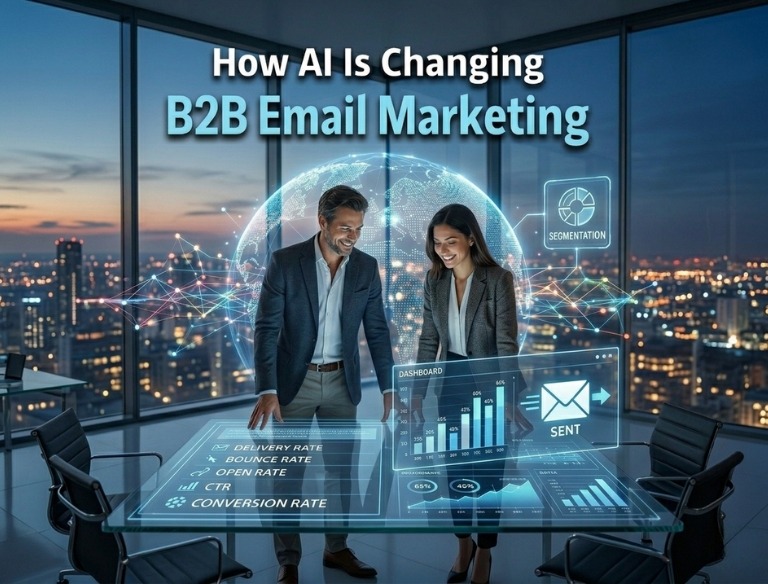
B2B email marketing is not going away. If anything, it has become more central to how companies generate and nurture leads, build relationships, and move buyers through longer, more complex sales cycles. What is changing — and changing quickly — is how teams actually execute their programs.
Understanding how AI is changing B2B email marketing is a question more marketing managers and business owners are asking every year. The short answer: AI helps teams segment more precisely, personalize more effectively, test more intelligently, and improve results faster. But it is not replacing the strategy, judgment, or brand voice that make email work in the first place.
This guide covers where AI fits into B2B email marketing today, what it helps with, where human thinking still matters most, and how to start using it in a practical and sustainable way.
| What this article covers → Why email marketing still matters in B2B → How AI is changing B2B email marketing today → The biggest benefits — and real-world use cases → Where human strategy still matters most → Common mistakes to avoid → Best practices and metrics to track → How to get started |
1. Why Email Marketing Still Matters in B2B
Before getting into AI, it helps to ground the conversation in why email remains such a valuable channel for B2B companies in the first place. Unlike social media or paid advertising — where reach depends on algorithms and ad budgets — email is an owned channel. Your list is an asset you control.
| Longer sales cycles B2B buyers rarely decide after one interaction. Email keeps your brand present over weeks or months of research — educating, building familiarity, and earning trust at every stage. | Multiple stakeholders A single B2B purchase often involves a department head, a financial decision-maker, and an end user. Email lets you address each with targeted, relevant content rather than one generic message. |
| “Your email list is an asset you control. Unlike paid channels, it does not disappear when you stop spending.” |
That combination — long buying cycles, multiple decision-makers, and full channel ownership — is exactly why email continues to outperform most other B2B marketing channels for lead nurturing and relationship development.
2. How AI Is Changing B2B Email Marketing Today
For years, B2B email marketing relied heavily on intuition, static contact lists, and broad assumptions about what buyers wanted to hear. AI is shifting that model by making it possible to work from actual behavior and data instead of guesswork.
Four areas where AI makes the biggest difference
| 01 | Segmentation AI analyzes behavioral signals — clicks, page visits, CRM history — and builds audience segments based on real intent, not just job title. |
| 02 | Content creation AI tools generate subject line variations, draft email copy, and create A/B test options in a fraction of the time it used to take. |
| 03 | Timing and testing AI recommends optimal send times per contact, runs smarter tests, and surfaces performance patterns that are hard to spot manually. |
| 04 | Funnel relevance Whether a contact is early in awareness or close to a decision, AI helps ensure the message they receive matches where they actually are. |
| → Key Takeaway: AI is not replacing the B2B email marketing strategy. It is making the execution of that strategy faster, more precise, and more scalable. |
3. The Biggest Benefits of AI in B2B Email Campaigns
When AI is applied thoughtfully, the results show up in places that matter to the business — not just in open rates. Here are the six benefits that have the most impact for B2B teams.
| Better targeting Precise segments mean fewer wasted emails and more messages reaching people with genuine interest. | Faster production AI can cut the time to draft, test, and launch a campaign — freeing teams to focus on strategy. | Deeper personalization Content tailored by role, industry, and buying stage — not just a first name in the subject line. | Smarter testing Faster feedback loops and more systematic experimentation lead to consistent performance gains. |
Beyond these four, AI also helps teams get more from the time they already have. When repetitive or data-heavy tasks are handled by AI, marketing managers can spend more energy on strategy, creative direction, and decisions that genuinely require human judgment.
The business-level outcomes worth tracking: better lead quality, stronger engagement rates, improved conversion from MQL to SQL, and more efficient use of marketing resources.
4. Top B2B Email Marketing Tasks AI Can Improve
AI is not a single platform or tool. It shows up across several parts of the email workflow. Here is where it tends to make the most practical difference for B2B teams today.
- Subject lines — Generate multiple variations quickly, flag spam triggers, and run systematic tests to find what resonates.
- Email copy drafts — AI produces solid first drafts of nurture emails, follow-up sequences, and promotional messages. These still need human review, but they eliminate the blank-page problem.
- Audience segmentation — Analyze engagement data, behavioral patterns, and CRM records to build dynamic, accurate segments rather than static lists.
- Send-time optimization — Recommend the best send time per contact based on individual engagement history, rather than defaulting to the same Tuesday morning send for everyone.
- Lead scoring and engagement tracking — Weight email behavior alongside other signals to help identify which contacts show the most buying intent.
- Funnel drop-off analysis — Surface where contacts are losing interest in a nurture sequence so messaging can be adjusted before the opportunity is lost.
5. How AI Helps With Segmentation, Personalization, and Automation
These three areas are where AI tends to have the most significant and sustained impact on B2B email performance. They are also the areas where the gap between AI-assisted programs and traditional programs is growing fastest.
Smarter segmentation based on behavior and intent
Traditional segmentation groups contacts by industry, company size, or job title. AI takes that further by incorporating behavioral data — which emails someone opened, which pages they visited, how recently they engaged, and what they did inside your CRM.
The result is segments that reflect real buying intent and engagement level, not just demographic similarities. That makes every message you send more relevant to the person receiving it.
Personalization that goes beyond first names
Inserting a first name is a starting point, not a personalization strategy. AI enables content personalization at a much deeper level — showing different value propositions to a CFO versus a marketing director, referencing the specific industry a contact works in, or surfacing content aligned with where someone is in the buying cycle.
Dynamic content blocks, powered by AI-driven logic, allow a single email template to deliver meaningfully different experiences to different segments — without requiring your team to build dozens of separate campaigns.
Automation that adapts to engagement
Traditional automation follows rigid rules: if someone opens an email, send the next one in three days. AI-enhanced automation is more flexible. It adjusts the pace of a nurture sequence based on how a contact is engaging, triggers different follow-up paths depending on what someone clicks, and pauses outreach when engagement signals suggest the timing is off.
| The goal is not more automation, it is smarter automation. Automation that adapts to real behavior feels more thoughtful and less mechanical to the person on the receiving end. Done well, it builds trust rather than eroding it. |
6. Best B2B Use Cases for AI in Email Marketing
AI adds value across many different types of B2B email campaigns. Here are the most common and effective real-world applications.
| ✓ | Lead nurturing across long sales cycles AI helps build nurture sequences that stay relevant over weeks or months — adjusting content based on where each contact is in the process rather than sending the same cadence to everyone. |
| ✓ | Event and webinar promotion AI can identify which contacts are most likely to register based on past behavior, so promotional effort is concentrated where it is most likely to pay off. |
| ✓ | Re-engagement campaigns AI flags contacts whose engagement has dropped and suggests re-engagement approaches tailored to their previous interactions — rather than sending a generic “we miss you” email to the entire inactive list. |
| ✓ | Post-demo and post-consultation follow-up After a sales conversation, AI-driven sequences help keep momentum going with relevant content that reinforces the discussion and addresses common objections. |
| ✓ | Customer onboarding and retention For existing clients, AI can personalize onboarding sequences, detect early signs of disengagement, and trigger timely outreach that supports retention and expansion. |
| ✓ | Account-based email campaigns For ABM programs, AI supports highly personalized content tailored to specific companies, industries, or decision-maker profiles — making outreach feel genuinely relevant rather than mass-produced. |
7. Where Human Strategy Still Matters Most
AI is a powerful support tool. It is not a strategic partner. There are areas where human thinking remains essential, and overlooking them is one of the most common ways AI-assisted email programs fall short.
| AI can help you say something faster. It cannot tell you what you should be saying. Defining the right message and offer requires understanding your buyers, your competitive position, and your business goals in ways no AI tool currently replicates. Buyer pain points come from sales conversations and customer interviews — not from data patterns alone. Your brand voice — the tone and personality that makes your company recognizable — requires human attention and editing to maintain in every email that goes out. Sales and marketing alignment remains essential. Email should reflect current conversations, real objections, and active opportunities — something AI cannot facilitate on its own. Every AI-generated email should be reviewed by a human before sending. AI outputs are a strong starting point, not a finished product. |
8. Common Mistakes B2B Marketers Should Avoid
AI can improve your email program, but it can also amplify existing problems if you are not careful. Here are the most common pitfalls.
| ⚠ Watch Out: Bad data leads to weak results — AI is only as good as the data it works with. Outdated contacts, duplicate records, or incomplete CRM information produces poor segmentation and personalization. Data quality is a prerequisite, not an afterthought. |
| ⚠ Watch Out: Too much automation hurts trust — Over-automating communication risks making it feel robotic and impersonal. Buyers can often tell when they are receiving a fully automated sequence with no human involvement — and it reduces trust rather than building it. |
| ⚠ Watch Out: Generic copy does not stand out — AI-generated drafts sent without sufficient editing and customization produce emails that sound like everyone else’s. Generic copy does not give buyers a reason to engage. |
| ⚠ Watch Out: Poor personalization damages credibility — Inaccurate personalization — referencing a company someone no longer works for, or an industry that does not match their role — hurts credibility more than generic messaging. Clean data and regular auditing are essential. |
| ⚠ Watch Out: Vanity metrics lead to wrong conclusions — Open rates and click-through rates are useful, but they do not tell you whether email is actually moving business forward. Optimizing for opens without connecting to pipeline contribution leads to optimization in the wrong direction. |
9. Best Practices for Using AI in B2B Email Marketing
Introducing AI into your email program works best when it is gradual, deliberate, and built on a clear strategic foundation.
- Define your goals before you choose your tools.
- Audit and clean your CRM data before AI can segment or personalize from it.
- Build a human review step into every AI-assisted campaign before it goes live.
- Test one variable at a time so you can understand what is actually driving improvement.
- Connect email to your landing pages, sales outreach, and content strategy so every touchpoint tells a coherent story.
- Treat AI outputs as first drafts, not finished work. Edit for brand voice, accuracy, and relevance every time.
10. Key Metrics to Track in AI-Driven Email Campaigns
Measuring the impact of AI in your email program requires looking beyond basic engagement metrics. Here is a framework organized by what each metric actually tells you.
| Category | Metrics to watch | What does it tell you |
| Engagement | Open rate, click-through rate, reply rate | Whether subject lines and content are resonating with your audience |
| Conversion | Form completions, meeting bookings, content downloads | Whether email is generating real engagement and moving contacts toward a conversation |
| Pipeline | MQL to SQL rate, pipeline contribution, revenue influenced | Whether email marketing is actually moving business forward |
| Deliverability | Unsubscribe rate, spam complaints, inbox placement | Whether your program is maintaining health and trust over time |
11. How to Start Using AI in Your B2B Email Strategy
Getting started does not require a complete platform overhaul. A gradual, deliberate approach tends to produce better results than trying to implement everything at once.
- Review your current email program — Audit what you already have. Look at data quality, segmentation, and where your biggest gaps or bottlenecks are. That review will tell you where AI is most likely to make a meaningful difference.
- Choose one use case first — Pick one specific area to test: subject line generation, send-time optimization, or segment refinement. A focused starting point is easier to evaluate and builds confidence for broader adoption.
- Run a small pilot — Test your AI-assisted approach against your current approach with a subset of your audience. Set clear success criteria before you start.
- Measure results honestly — If the AI-assisted approach performed better, identify why and build on it. If it did not, understand what got in the way before expanding the test.
- Build a repeatable framework — Once an approach is proven, document it and make it part of your standard process. AI works best when it is integrated into a consistent workflow.
12. The Future of AI in B2B Email Marketing
AI capabilities in email marketing are continuing to mature. A few trends are worth keeping in mind as you plan ahead.
| More predictive journeys Future AI tools will increasingly anticipate what a buyer needs next – reaching people with the right content before they even know they need it, rather than reacting to past behavior. | Strategy matters even more As AI tools become more accessible, the differentiator will not be the technology itself. It will be the companies that use it most strategically, built on clear positioning and genuine buyer understanding. |
Companies that invest in clean data, strong strategy, and thoughtful AI adoption now will have a meaningful competitive advantage as these tools continue to improve. The technology is getting better quickly. How you use it is what will set you apart.
Final Thoughts on How AI Is Changing B2B Email Marketing
Understanding how AI is changing B2B email marketing is not just about keeping up with technology. It is about finding smarter ways to reach buyers, build trust over longer sales cycles, and make better use of the marketing resources you already have.
AI helps teams segment more precisely, personalize more effectively, test more intelligently, and move faster. But the best results still depend on clean data, clear strategy, strong messaging, and human review. Companies that build those foundations first — and then layer in AI thoughtfully — will be in the strongest position to compete.
| → Key Takeaway: The technology is ready. The question is whether your strategy, your data, and your team are ready to use it well. |
| Want to Improve Your B2B Email Marketing Strategy? WSI Digital Path works with B2B companies to build smarter email programs — from segmentation and automation to content and performance tracking. If your email program is producing inconsistent results, we can help. |
FAQ: How AI Is Changing B2B Email Marketing
| Q: How is AI used in B2B email marketing? |
AI is used across segmentation, subject line and copy generation, send-time optimization, lead scoring, engagement tracking, and automation logic. It helps marketing teams work faster and make more data-informed decisions throughout the email workflow.
| Q: Can AI improve B2B email campaign performance? |
Yes, when implemented thoughtfully. AI can improve targeting precision, increase personalization relevance, accelerate testing cycles, and surface performance insights that are difficult to identify manually. Results depend heavily on data quality and the strength of the underlying strategy.
| Q: What are the best uses of AI in B2B email marketing? |
The most impactful applications tend to be behavioral segmentation, content personalization by persona or funnel stage, AI-assisted subject line and copy drafting, predictive send-time recommendations, and smarter lead nurture automation.
| Q: Is AI replacing email marketers? |
No. AI handles repetitive or data-heavy tasks more efficiently, but it cannot define strategy, understand buyer relationships, make brand decisions, or replace the judgment required to build effective campaigns. Marketers who use AI well tend to become more productive and more strategic — not redundant.
| Q: What should B2B companies do before using AI in email campaigns? |
Audit your contact data quality, clarify your email strategy and goals, review your current segmentation approach, and identify one specific area where AI is most likely to add immediate value. A clean foundation makes AI significantly more effective.

Tali is a results-driven digital marketer with a track record of growing her clients’ businesses and driving revenue.
As the business owner at WSI Digital Path, Vaughan, she takes great pride in delivering powerful but cost-effective solutions for her clients.
Innovative and revolutionary digital marketing trends set the pace for the digital marketing industry. Don’t make the mistake of falling behind! Contact WSI Digital Path today and trust your digital marketing to the industry’s leading professionals.